
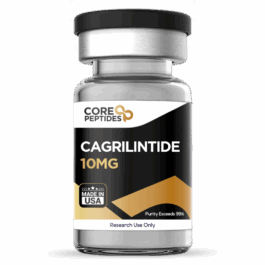


Cagrilintide Peptide
Cagrilintide is suggested to belong to the dual amylin and calcitonin receptor agonist (DACRA) class of peptides. This suggests that during laboratory research, the peptide may engage both the amylin receptor (AMY-R) and the calcitonin receptor (CTR), which are closely related but mediate partly different metabolic actions. Activating the AMY-R may play a role in hunger hormone signaling and regulation, while CTR signaling may play a role in the dynamics of carbohydrate metabolism in research models.
Based on this, research conducted by scientists like Larsen et al. suggests that DACRAs such as Cagrilintide may have the potential to modulate several nodes of energy and glucose homeostasis at once, rather than acting on a single pathway.(1) This positions them as promising research peptides for dissecting how coordinated AMY-R/CTR signaling might interact with hunger hormone signaling circuits, glucose handling, and insulin dynamics in experimental systems.
Chemical Makeup
Other Known Titles: AO43BIF1U8, GLXC-26801, AM833
Molecular Weight: 4409 g/mol
Molecular Formula: C194H312N54O59S2
Research and Clinical Studies
Cagrilintide Structure and Receptor Activation
According to researchers such as Dehestani et al., Cagrilintide appears to carry several modifications that differentiate it from other DACRAs.(2) This includes an acylation with a fatty acid moiety attached to the N-terminal lysine and several amino acid substitutions. Cagrilintide stands out with a prolonged potential for action, which likely stems from its N-terminal acylation, which promotes reversible binding to any albumin in the evaluation media.
This albumin association may shield the peptide from rapid enzymatic degradation and create a reservoir that slowly releases free Cagrilintide over time, thereby prolonging cellular exposure. Specifically, Cagrilintide appears to have a half-life of 159–195 hours after a single exposure, with peak levels released within 24 hours of the evaluation. In comparison, research by Eržen et al. comments that the endogenous amylin “has a short half-time in plasma (~13 min)”.(3)
The amino acid substitutions in Cagrilintide, together with the acylation, appear to support molecular stability potentially and may subtly alter receptor interaction kinetics, for example, by slowing dissociation from the receptor complex. Specifically, research by D’Ascanio et al. clarifies that some of these substitutions include the replacement of asparagine at position 14 with glutamate and valine at position 17 with arginine.(4) These oppositely charged residues may interact to form an intrahelical salt bridge, which helps stabilize the central α-helix and reduces the propensity for spontaneous deamination at the original Asn site. In parallel, the endogenous residues at positions 25, 28, and 29 are replaced by proline, a residue that disrupts regular backbone geometry and strongly disfavors β-sheet formation.
This β-sheet disruption is particularly important because endogenous amylin has a pronounced tendency to misfold and self-aggregate into β-sheet–rich oligomers and fibrils, which may be cytotoxic to β-cells and destabilize peptide preparations by generating visible and subvisible particles. In experimental and formulation contexts, such aggregation not only raises potential immunogenicity concerns but also reduces the amount of monomeric, bioactive peptide available. Thus, Cagrilintide is engineered to be markedly less aggregation-prone than endogenous amylin, making it more suitable as a stable, long-acting amylin/calcitonin receptor agonist in research settings.
Cagrilintide and Amylin Receptor Signaling
As mentioned, Cagrilintide is considered a non-selective agonist at both amylin receptors (CTR+RAMP complexes) and calcitonin receptors. Specifically, the research of Boyle et al. clarifies that the AMY-Rs are considered structures made from a calcitonin receptor core combined with receptor-activity-modifying proteins (RAMP1/2/3). AMY-Rs are the main receptors activated by Cagrilintide.(5)
Boyle et al. posit that the AMY-Rs are typical for specific species of nerve cells, such as caudal hindbrain neurons.(5) Activation of these AMY-Rs by agents like Cagrilintide is posited to rapidly activate neuronal circuits that promote satiation signaling and suppress hunger hormone signaling. Molecules that exert AMY-R affinity, such as Cagrilintide, may also interact with nerve cells, which may regulate gastric cell motility.
The peptide may interact via the area postrema nerve cells and vagal nerve cells, which typically regulate the rate at which stomach contents are delivered into the small intestine. This may slow down the absorption by mammalian gastric and intestinal cells of different nutrients, such as glucose. This signaling may also interact with pancreatic cells and liver cells. Specifically, Cagrilintide may suppress the synthesis of glucagon in pancreatic cells and the production of new glucose molecules in liver cells.
The research by Boyle et al. also suggests that in hypothalamic cells, AMY-R activation may support the signaling of the satiety hormone leptin, which may be mediated at least partly via IL-6–dependent changes in leptin receptor trafficking and sensitivity in specific neuronal populations.(5) This leptin-sensitizing action positions Cagrilintide as a potential adiposity signal amplifier, aiding nerve cells to read and respond more supportively to signals of energy stores.
Cagrilintide and Calcitonin Receptor Signaling
The previously mentioned research by Larsen et al. suggests that CTR signaling is also an important aspect that mediates some of its potential.(1) CTR activation seems to recruit many of the same nerve cells as amylin, but with a slightly different functional emphasis. These include neurons typical for the caudal hindbrain, including the area postrema and nucleus of the solitary tract. Through these actions, the CTR agonism of Cagrilintide may contribute to reduced gastric cell and tissue motility and altered islet cell hormone dynamics.
Larsen et al. highlight that at the same time, CTR signaling may have a distinct role in basal glucose homeostasis that is only partly overlapping with amylin pathways.(1) CTR is present in peripheral metabolic tissues and possibly in specific hypothalamic neurons, and research models link their signaling with support for glucose and even lipid metabolism. This may be mediated via numerous CTR activation in different cell populations by Cagrilintide. CTR activation may preferentially modulate liver cell glucose production, muscle cell glucose disposal, and pancreatic β-cell insulin capacity. However, the actions appear to be only supporting the main amylin signaling.
Cagrilintide’s Potential on Carbohydrate and Lipid Metabolism
In experimental model systems, exposure to Cagrilintide has been associated with pronounced reductions in total tissue mass, with some experiments reporting decreases approaching ~10% versus controls over the course of an intervention. These changes appear to be driven predominantly by loss of energy-storing depots (e.g., adipose tissue), accompanied by shifts in metabolic readouts such as better-supported carbohydrate and lipid metabolism, and markers consistent with increased lipid mobilization and oxidation. Researchers such as Eržen et al. report that they have observed reduced nutrient intake and delayed nutrient delivery from the gastric cells, suggesting that Cagrilintide may support both central satiety circuits and peripheral handling of nutrients.(3)
Cagrilintide’s Potential Synergy with GLP-1 Receptor Activation
Research by Züger et al. suggests that Cagrilintide may possess synergistic potential with agents activating the GLP-1 receptors.(6) The researchers suggest their activation may also engage hypothalamic circuits to modulate insulin secretion by pancreatic cells, glucagon secretion by hepatic cells, and gastric cell motility. But the GLP-1 receptors are found on different populations of area postrema nerve cells. Because of this partial segregation, Cagrilyntide may be complemented by the activation of GLP-1 pathways rather than simply overlapping. The previously mentioned research by Larsen et al. also suggests that “these separate, but related mechanisms of action of an amylin-analog and a GLP-1 receptor agonist appear to have an additive effect on [hunger hormone] reduction.”
As already noted, Cagrilintide may sensitize leptin signaling via IL-6 from microglia, whereas Züger et al. suggest that in hypothalamic nerve cells, GLP-1 signaling may predominantly modulate pancreatic islet cell hormone dynamics. In combination, dual amylin–calcitonin agonism via Cagrilintide plus GLP-1 receptor activation might, at least experimentally, coordinate multiple, partly non-redundant neural and endocrine nodes controlling nutrient inflow, glycemia, and adipose cell energy storage.
Cagrilintide peptide is available for research and laboratory purposes only. Please review our Terms and Conditions before ordering.
References:
- Larsen AT, Sonne N, Andreassen KV, Karsdal MA, Henriksen K. The Calcitonin Receptor Plays a Major Role in Glucose Regulation as a Function of Dual Amylin and Calcitonin Receptor Agonist Therapy. J Pharmacol Exp Ther. 2020 Jul;374(1):74-83. doi: 10.1124/jpet.119.263392. Epub 2020 Apr 21. PMID: 32317372.
- Dehestani B, Stratford NR, le Roux CW. Amylin as a Future Obesity Treatment. J Obes Metab Syndr. 2021 Dec 30;30(4):320-325. doi: 10.7570/jomes21071. PMID: 34929674; PMCID: PMC8735818.
- Eržen S, Tonin G, Jurišić Eržen D, Klen J. Amylin, Another Important Neuroendocrine Hormone for the Treatment of Diabesity. Int J Mol Sci. 2024 Jan 26;25(3):1517. doi: 10.3390/ijms25031517. PMID: 38338796; PMCID: PMC10855385.
- D’Ascanio AM, Mullally JA, Frishman WH. Cagrilintide: A Long-Acting Amylin Analog for the Treatment of Obesity. Cardiol Rev. 2024 Jan-Feb 01;32(1):83-90. doi: 10.1097/CRD.0000000000000513. Epub 2023 Oct 20. PMID: 36883831.
- Boyle CN, Zheng Y, Lutz TA. Mediators of Amylin Action in Metabolic Control. J Clin Med. 2022 Apr 15;11(8):2207. doi: 10.3390/jcm11082207. PMID: 35456307; PMCID: PMC9025724.
- Züger D, Forster K, Lutz TA, Riediger T. Amylin and GLP-1 target different populations of area postrema neurons that are both modulated by nutrient stimuli. Physiol Behav. 2013 Mar 15;112-113:61-9. doi: 10.1016/j.physbeh.2013.02.006. Epub 2013 Feb 21. PMID: 23438370.
| Quantity | 5 – 8, 9 + |
|---|
Be the first to review “Cagrilintide (10mg)”
Related products

Peptide For Sale
Peptide For Sale

Peptide For Sale
Peptide For Sale
Peptide For Sale

Peptide For Sale
Peptide For Sale
Peptide For Sale
Reviews
There are no reviews yet.